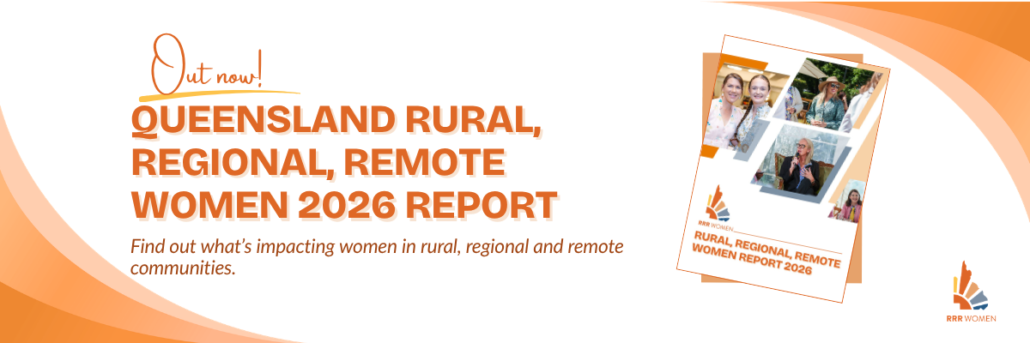
The Queensland Rural, Regional, Remote Women 2026 Report is out now.
It measures conditions impacting women in Queensland, alongside your wants, needs and where you see hope and optimism in the future.
This report presents findings from the 2026 research and builds on the inaugural 2025 report. It identifies emerging issues, tracks year-on-year changes and maps the evolving realities of women living, working and playing across rural, regional and remote Queensland.
The aim is to understand the evolving realities of women across Queensland across a series of measures like:
- News and digital access and connectivity
- Employment, industry representation and volunteering
- Community services and accessibility
- Connection and social cohesion
- Disaster impact
- Climate and energy
- Future opportunities
- Leadership and advocacy
Now in its second year, the data shows a snapshot of adaptable and optimistic Queensland communities navigating increasing and compounding complexity.
While women continue to demonstrate strong leadership and community commitment, they also report persistent challenges in accessing essential services, responding to disasters and managing the urban rural divide. Key data stories are:
- The evolving nature of multi-generational leadership and regional diversification: More women work in multiple industries, consulting roles or hybrid careers while there is increasing representation from younger women in leadership and professional roles.
- The gap between digital reliance and digital access: Social media and digital services are increasingly being used not only socially, but professionally and strategically but there is a persistent gap between reliance on digital platforms and actual accessibility.
- The hidden volunteer economy: About a quarter of women volunteer between 10 and 20 hours a week.
- Persistent challenges in service accessibility: Technology and digital services showed the strongest improvement, despite a persistent gap in access, while general grocery items experienced the largest decline and health and childcare were consistently weak year on year.
- Supply chain disruptions are the most common disaster impact: Weather continues to have a profound effect on rural, regional and remote women through infrastructure disruption, supply chain impacts and economic insecurity.
- Women are increasingly influencing policy and decision making in areas like investment and energy policy: Close to 65% of respondents said mentoring and skills development programs would be the most significant contributor to women in their community having a stronger voice in decision-making.
- Value of social connectivity for support: Social connection, belonging and purpose appeared consistently throughout qualitative responses and represented one of the strongest recurring themes in the 2026 survey.
About the research
The research provides rich data to help decision makers, corporates, local, state and federal governments, not-for-profits and community groups deliver services, investment and resources for rural, regional and remote women and your communities best suited to your needs and wants.
It also means we are able to deliver the best value to our members, responsive to what you’re telling us, and advocate to all levels of government for rural, regional and remote Queensland women.
We’re working to ensure rural, regional and remote women’s voices are heard and insights are acted on.
Participating in the study is rural, regional and remote women’s opportunity to foreground your wants and needs and have your valuable insight, thoughts and perspective make a difference to women like you across the state.
Update your details to be the first to know when future surveys open and reports are published.
See where the data is used
- Media release: New report shows optimism among regional Queensland women while exposing growing pressures
- FY26 State Budget submission
- Queensland Volunteering Inquiry submission
- Submission to the Joint Standing Committee on Northern Australia- Preparing for emerging industries across Northern Australia
- FY27 State Budget submission
- Budget update: What the FY27 Queensland Budget means for rural, regional and remote women – RRR Women
- Media release: New research shows how rural Queensland women recognise economic and service inequality and what impact it has on hope for the future
- Media release: Five priorities driving outcomes for rural, regional and remote women at State Parliament – RRR Women
- Media release: Rural women to take their priorities to State Parliament this November – RRR Women
Read the Queensland Rural, Regional and Remote Women 2025 Report
For the first time in 2025, we asked close to 500 Queensland women about how the urban rural divide, access to services, mental health, natural disaster and drought, connection and social inclusion impacted you.
The data tells a powerful story: rural women are the backbone of their communities, sustaining them through work, caregiving, and resilience in response to crisis, yet lack the recognition, resources, and services they need to continue making this immeasurable impact long-term.
Key data stories
The digital divide and media consumption shift
- Social media (76.75%) is the primary news source, far surpassing traditional media like TV (53.73%) and newspapers (25%).
- Despite high social media use, access to digital resources and internet services is below average, demonstrating a gap between reliance on digital platforms and actual digital accessibility.
Unpaid and volunteer work: The hidden economy
- Close to a quarter (24.02%) engage in both paid and unpaid work, while another 26.33% work entirely unpaid.
Volunteering is widespread: 36.27% contribute at least 10 hours per week. - More than half 50% of women engage in some form of unpaid labor, either fully or alongside paid work.
Mental health and isolation
- While 53.2% feel highly connected to family, only 18.13% feel highly connected to a professional network.
- More than 93% are concerned about mental health issues in their communities.
Hope and future opportunities
- Despite challenges, respondents are hopeful about opportunities for their families and communities.
Family and support networks are key sources of hope. - While official support services are lacking, women rely heavily on family, friends, and informal networks for help.
Natural disasters: Ongoing recovery and resilience
- Supply chain (80.37%), power and communications disruptions (80.4%), live stock loss (80.77%), transport (84.62%) and road infrastructure damage (86%) were the most common impacts from flood, cyclone, fire and drought in the past five years.
- 9.12% experience disaster-related impacts lasting more than five years, affecting long-term stability.
Economic and service inequality
- Access to critical services (affordable energy, childcare, internet and telecommunications technology and health services) is poor.
- Banking and postal services have some of the worst accessibility scores.